
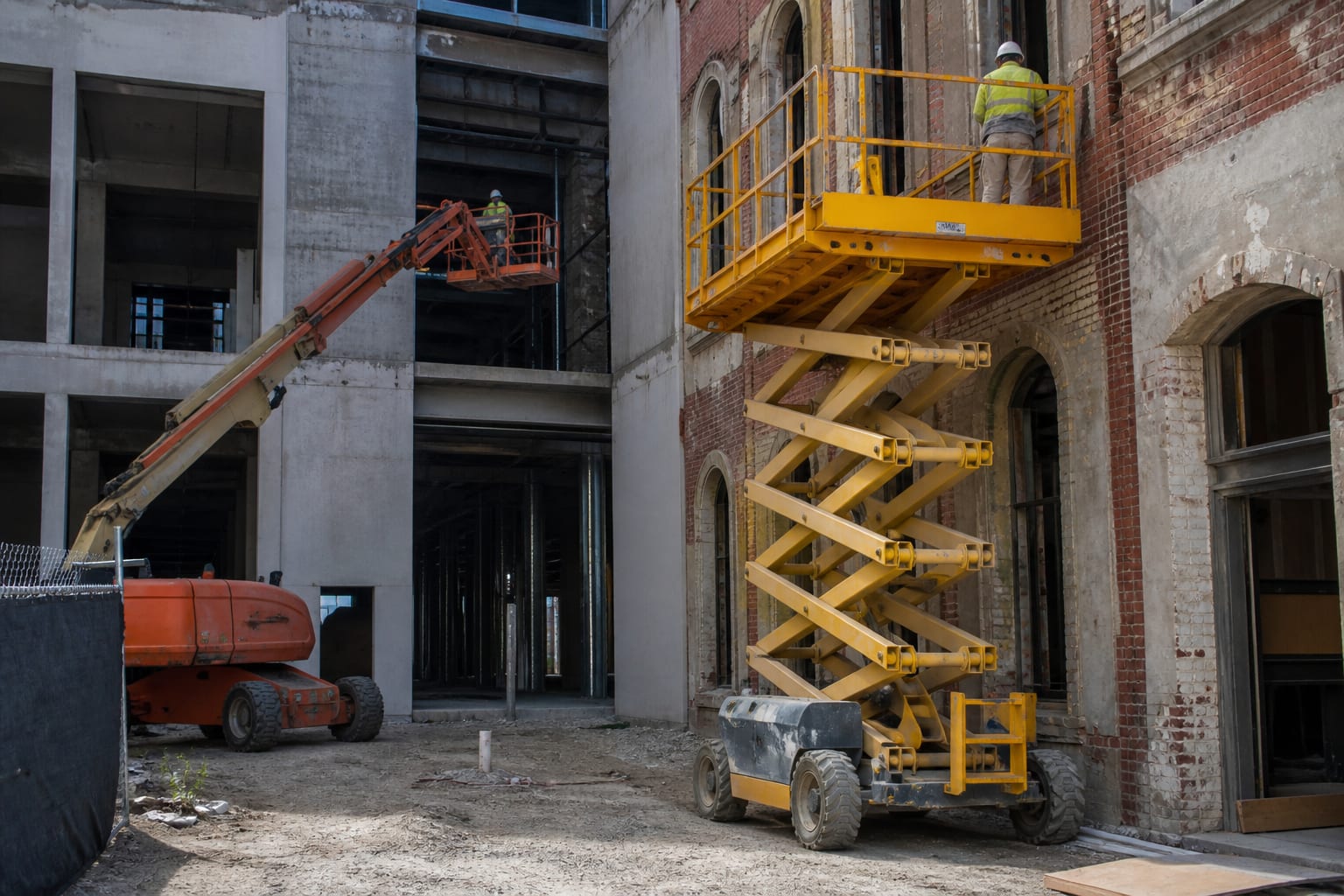
Choose a scissor lift when the work is vertical and the floor is flat and firm; choose a boom lift when you must reach over, around, or away from an obstacle, or when the ground outside is uneven. That single distinction resolves most aerial platform hires before price enters the conversation.
Working height, outreach, floor loading, and certification then decide which specific machine fits. Below is a practical frame you can apply to a warehouse fit-out, a facade repair, or a hall with racking in the way.
Advertising
Utilaro
Publicitate pe Utilaro
Spatiu disponibil pentru furnizori, servicii si branduri din domeniul utilajelor.
Choose a scissor lift when
The task sits more or less straight above the deck: lighting, ducts, sprinklers, ceilings, racking, signage, and indoor maintenance. Scissor lifts give you a large, stable platform, generous capacity for two people plus material, and a compact footprint. Electric models with non-marking tyres are built for finished floors and indoor air, and rough-terrain versions handle compacted yards.
The trade-off is that a scissor only goes up. If a duct, a canopy, or a parked machine sits between you and the work face, you will spend the shift repositioning instead of working.
Choose a boom lift when
You need to work over an obstacle, above a roof edge, across a hedge or facade detail, or from a chassis that cannot sit directly under the work. Articulating booms bend around obstructions and reach into structures; telescopic booms deliver maximum horizontal outreach at height.
Booms cost more per day, need more space to set up, and are more sensitive to ground bearing, slope, and wind. In exchange, one setup can cover a work area that would take a scissor lift several moves to reach.
Site checklist before you book
— Indoor or outdoor, and the surface: slab, asphalt, compacted fill, or soft ground.
— Working height needed at the work face, not the brochure maximum.
— Horizontal outreach and the obstacle you have to clear.
— Platform capacity: people plus tools plus material.
— Floor or ground loading, including point loads under wheels and outriggers.
— Access route: door width, ceiling height, ramps, turning space.
— Power and emissions: electric for indoor, diesel or hybrid for yards.
— Wind limits, exclusion zones, and rescue plan for the working shift.
— Operator certification, familiarisation, and harness or restraint policy.
Working height versus outreach
Platform ratings describe the machine, not your task. Measure from where the operator actually has to stand and work, add the reach the tool needs, then keep a margin — a lift used at its absolute limit is slower and less safe than one class up. Remember that outreach on a boom falls as capacity rises, so check the load chart for the combination you plan to use, not just the headline numbers.
Certification matters as much as the machine. Dry-hiring a boom lift without a trained, familiarised operator is a common way to lose days to inspections, near-misses, and a stalled programme.
FAQ
Can a scissor lift be used outdoors? Rough-terrain models can, within their slope and wind limits. Standard electric indoor units should stay on firm, level surfaces.
Which is cheaper to hire? A scissor lift is usually cheaper per day, but the boom can be cheaper per job when it eliminates repositioning or scaffolding.
Do I need a harness in a scissor lift? Follow the manufacturer and site rule. Booms normally require a full-body harness with a lanyard attached to the basket anchor.
How do I choose between articulating and telescopic booms? Articulating for obstacles and up-and-over work, telescopic for maximum straight-line outreach at height.
Compare platforms on Utilaro
Open the aerial platforms hub to see scissor and boom options side by side, or browse all equipment for rent. Refine with search by region, transport, and operator, and find certified crews under operators.
State indoor versus outdoor, working height, outreach, and operator needs in your very first message — owners answer specific briefs faster. If you are still deciding on the crew model, read operator included vs dry hire, and for the wider process see how to rent construction equipment.